The Art City
The city of Ostuni was officially awarded the title of "City of Art" in 1998 for its historical, artistic and landscape beauties. Ostuni is the destination for those who appreciate the combination of culture and environment.
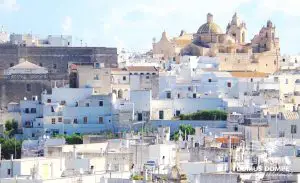
The origins of the city of Ostuni are far in the past, Ostuni boasts a cultural heritage at least in part still to be discovered. The old town, itself a monument and place of the historical past, has an extraordinary charm. The medieval old town, a labyrinth of streets, arches and alleys, bordered by the imposing curtain wall, has remained intact to this day. The white lime-painted labyrinth - from which the name "White City" derives - alternates with the warm ocher color of the stones of the ancient palaces, churches, monasteries and imaginative portals.
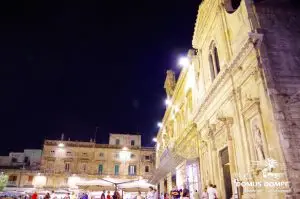
Piazza della Libertà boasts a centuries-old history that dates back to 1304, when the land to build the convent and the church was granted to the Franciscan friars of the convent by Philip of Anjou, prince of Taranto and lord of Ostuni.
In 1806, due to the laws of the decade of French domination (1806-1815), the Franciscan friars were dismissed and the entire building was purchased by the representatives of the citizens.
The square in front of the former convent, later named after San Francesco (Piazza San Francesco), was very small and almost cramped. However, it was the place where the market took place every day, where job seekers went, and it was also home to numerous shops, workshops and offices.
Due to the fact that this square was becoming increasingly important from an economic point of view for Ostuni, the municipal administrators decided in 1861 to demolish some buildings such as the military command, the clock tower, the Ognissanti church, the hospital, as well as many apartments and shops, so that the new square had more space and thus increased in size. Eventually it took the name of Piazza XX Settembre.
In the Fascist era the same square was renamed Piazza Impero and only in 1943 did it take on its current name of Piazza della Libertà.
Also following the expansion of the square in 1861, the square was heavily redesigned, so much so that the original appearance was also changed.
The level of the square was raised by a few meters so that the column dedicated to Sant'Oronzo, patron saint of the city, was at least partially buried. Even some palaces were reduced to make room for Corso Vittorio Emanuele.
In 1950, a fountain in nearby Piazza Sant'Oronzo, previously called Piazza Fontana, was destroyed. It was built in 1926 during the fascism.
Finally, at the end of the 1960s, the old headquarters in Piazza del Mercato, dating back to 1928 and already dilapidated, were demolished. It has been replaced by a public building.
Of particular interest was also the so-called “Lu strett de San Brangisc”. It was a bottleneck that had formed between the Church of San Francesco and the Palazzo Littorio (today Circolo Cittadino): the two buildings were so close to each other as to constitute a serious danger to traffic. In 1934 the mayor Luca Mindelli commissioned the engineer De Angelis to restrict the buildings facing the church and to redesign the front elevations.