The Masseris
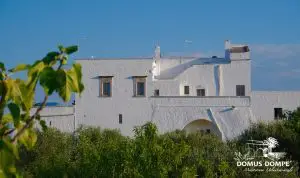
The masserie of Ostuni perfectly blend into the landscape and complement the beauty of the area and are evidence of the choice of the population to dedicate themselves to nature. All over this area, from the sea to the hills, there are around 300, among villas, farms, masserie and castles, almost always property of knights, marquises, barons and rich feudal lords that used these structures as their homes.
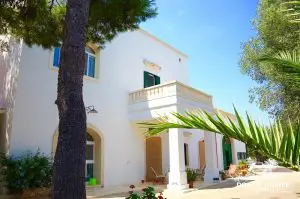
Today however, they are not just simple monuments of the past, but are used as means to develop future tourism. Many of these, in fact have been converted into agriturist properties capable of mixing tradition with the comforts of modern life (in the photo beside Rialbo above).
Carestia
The “Carestia” masseria was built between 1752 and 1777 a few yards from the sanctuary of Sant’Oronzo , patron saint of the small town and of San Biagio, on the slopes of one of hills of the forest. Enclosed by a long boundary wall, there are two entrances, one of which is characterised by a row of 15 arches that are equally spaced and vine-covered.
From the courtyard, there is access to the house of the Signore, one of the most elegant of the period, built on two floors, to the farmhouse, the church, stables and the rooms which house a splendid collection of old horse carriages.
At the entrance to the church, on an architrave, there is the inscription “qui non si gode di asilo” (here there is no refuge), which was requested by the prelate at the end of construction, as well as the date of the end of the construction “1752”.
In the Carestia masseria cheeses are produced which are typical Puglia dairy products, and other delicacies from the typical cuisine of Ostuni.
Lo Spagnulo
The masseria /fortified castle Lo Spagnulo is about 5 km from Ostuni. One arrives there either by the SS Road 16 or by the road linking Ostuni and Rosa Marina. The name “Lo Spagnulo” dates back to its first occupant who went by the name of Don Saverio Lopez y Royo, the son of Bartolomeo of Pamplona, and was built in 1680.
One could believe that the boundary wall, which architecturally has very narrow lines, originates from the middle ages. However, in fact it only dates back to the eighteenth century. Two entrances lead into the extensive inner courtyard. Located In the centre are beautiful baroque stone steps, which are accessible on two sides and lead up to the residence of the owner family. On the balustrade you find the inscription: “Parva sed apta”.
The masseria also has a four-edged tower, a small church, apartments, stables and an old completely intact oil mill.
Very much worth seeing is the “hall of tertullis”, a hall in baroque style, in the middle of which is a large basin with ibexes around it giving it the impression of a Greek temple.
Monticelli
Monticelli is reached by the SS road 16 at the km 874 exit. The country home has an old centre from the 15 th century. Its extensions and renovations were added later in the 17 th century. The manor house has a library containing 3,150 books as well as every type of furniture and countless records of the past. There is also an oil mill hewn out of the rock, where the process of the manufacture of olive oil has been reconstructed. In addition there is a noteworthy collection of old implements that were used in agriculture, handicrafts and in the home.
Refrigerio
The Refrigerio masseria is in Marina di Ostuni, close to the sea high up on the Costa Merlata. It is reached by the highway between Bari and Brindisi.
In the 1500’s the Franciscans built a small settlement along the old Via Traiana, which they called “Refrigerio” (cooling place), as they were used as rest houses for travellers.
At the end of the 18 th century, “Refrigerio” became an important farm, agricultural activity flourished and finally the main house of today’s masseria was built. Traces of the past can undoubtedly be seen, when it was very important to defend against raids from robbers and pirates that at the time were quite common.
Si accede alla Masseria attraverso un grande portale all’ingresso. Questo è collegato al muro di cinta che racchiude l’intero edificio della Masseria.
Monticelli a Mare (Sansone)
One enters the masseria through a large gate at the entrance. It is connected to the boundary wall, which surround the whole grounds of the masseria.
One reaches the masseria through an impressive crescent-shaped entrance made from Puglia stone, over which is the coat of arms of the Sansone family. Through the mighty entrance gate, one reaches the inner courtyard. Here there is the baroque masseria with eighteenth century influences and numerous dwellings, some of which are still in a good condition.
One should also mention the church, in which some of the family members are buried as well as an area in front of the boundary wall where there is a cattle trough.
Rialbo disopra
This old fortified manor house is about 5 km from the “white town” (reachable from the Ostuni – Fasano highway). This is the oldest masseria in the Ostuni area (1579). The centre of the property dates back to the 16 th century and was enlarged at different times. Of particular interest are the structures, which were used to defend the property: the drawbridge (later modernised and made from stone, a brattice, trapdoors and a massive boundary wall. The manor house and the buildings used as barns and storehouses are in good condition.
The masseria that offers a lot of land for agricultural cultivation has contributed a great deal to the wealth of the area.
satia
About 18 km from Ostuni on the country road in the direction of Martina Franca, there are two trulli farms “Satia Grande” and “Satia Piccola”. Important elements here are the trulli , which had different functions in a farm and were used as barns, storehouses and dwellings.
The first estate, “Satia Grande”, (large satin) consist of more than 20 trull i, some of which have slanting sloping roof surfaces.
Not far from here, there is the “Trullo Sovrano” (sovereign trullo ), a building made of three large Trulli, two of which are two-storied. The unknown builder of this trullo , by using the name sovereign, undoubtedly intended to convey the idea of the humble peasant life as being one of honour and worth.
Just a few hundred metres from here, there is the “Satia Piccola” (small satin), a row of small trulli with the dominating “Trullo Duomo” (cathedral trullo ).